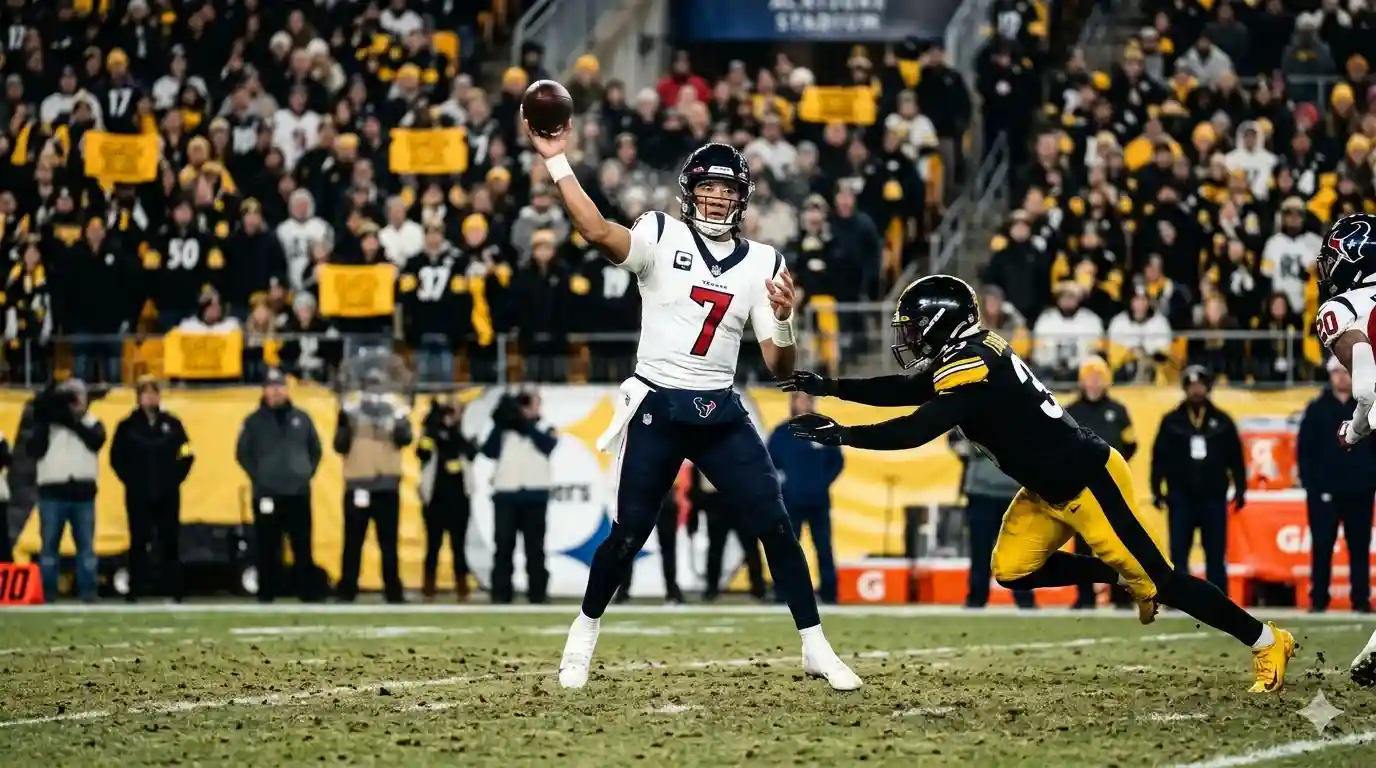
Texans vs Pittsburgh Steelers
Texans vs Pittsburgh Steelers
Finding verified, un-cluttered box scores and deeper player metrics right after a major game is frustrating. Most sports sites bury actual numbers under endless pop-up ads, superficial hot takes, and confusing walls of text. This definitive analytics breakdown delivers verified, detailed player performance data directly from the official logs.
Analyzing the official texans vs pittsburgh steelers match player stats reveals exactly how the tactical chess match unfolded on the field. The Houston Texans secured a dominant 30-6 victory over the Pittsburgh Steelers at Acrisure Stadium during the AFC Wild Card playoff round. From the first kickoff, head coach DeMeco Ryans stifled Mike Tomlin’s team with a balanced offensive plan and an aggressive, ball-hawking secondary.
Quarterback Breakdown: C.J. Stroud Outshines Aaron Rodgers
When evaluating the complete texans vs pittsburgh steelers match player stats for the quarterbacks, the contrast in efficiency stands out immediately. Houston quarterback C.J. With remarkable poise, Stroud controlled the pocket and swiftly distributed the ball to thwart the edge rush. He executed the play-action playbook cleanly, keeping the linebackers frozen in the middle of the field.
Pittsburgh turned to veteran quarterback Aaron Rodgers to spark their passing game, but the Houston defensive front disrupted his rhythm early. The pass rush collapsed the pocket consistently, forcing quick check-downs and hurried throws. Rodgers struggled to find open windows downfield against tight man-to-man coverage schemes.
| Quarterback | Completions / Attempts | Passing Yards | Touchdowns | Interceptions | Passer Rating | Sacks Taken |
| C.J. Stroud (HOU) | 21 / 32 | 250 | 1 | 1 | 86.7 | 0 |
| Aaron Rodgers (PIT) | 17 / 33 | 146 | 0 | 1 | 50.8 | 4 |
Advanced Passing Metrics and Efficiency Ratings
A closer look at this tier of the texans vs pittsburgh steelers match player stats underscores the structural victory of the Houston passing game. Stroud averaged a healthy 9.4 average depth of target, consistently pushing the ball past the first-down markers. He completed 50% of his passes beyond the sticks, keeping the chains moving during critical third-down situations.
Rodgers faced intense pressure throughout the night, completing just 5 of 13 attempts when the pocket collapsed. The Houston defense forced him into a late-game panic, resulting in a crucial red-zone interception that ended any hopes of a comeback. Houston eliminated big plays over the top, limiting Pittsburgh to an average of just 2.3 yards per offensive play.
Rushing Dominance: Woody Marks Controls the Ground Game
Shifting to the ground game inside the texans vs pittsburgh steelers match player stats spotlights a true breakout performance on the turf. Rookie running back Woody Marks carried the offensive load with incredible physicality despite picking up a minor knock early in the contest. He regularly gained positive yardage after contact, punishing the defensive front seven of the opponents.
The offensive line generated excellent movement at the point of attack, opening clean lanes in the zone-running game. Nick Chubb provided stellar relief appearances to keep the backfield fresh during the second half. Pittsburgh simply could not find answers for the constant interior pressure generated by the Houston run blockers.
| Running Back | Rushing Attempts | Rushing Yards | Average Yards Per Carry | Longest Rush | Touchdowns |
| Woody Marks (HOU) | 22 | 112 | 5.1 | 24 | 1 |
| Nick Chubb (HOU) | 8 | 34 | 4.3 | 11 | 0 |
| Kenneth Gainwell (PIT) | 11 | 42 | 3.8 | 13 | 0 |
Receiving Directives: Christian Kirk Torches the Secondary
The aerial distribution in the texans vs pittsburgh steelers match player stats features a masterclass from wide receiver Christian Kirk. Kirk operated primarily out of the slot, exploiting mismatches against the opposing defensive backs with precise route running. He logged a massive 144 receiving yards, including a dynamic 46-yard reception that set up a crucial scoring drive.
Next Gen Stats data shows that Kirk recorded most of his production when isolated against man coverage on the perimeter. By drawing coverage away from the middle and clearing off the safeties, Nico Collins and Jayden Higgins performed their responsibilities flawlessly. Dalton Schultz provided a reliable safety valve on short crossing routes when the pass rush flashed.
| Receiver | Receptions | Receiving Yards | Average Per Catch | Targets | Touchdowns |
| Christian Kirk (HOU) | 8 | 144 | 18.0 | 9 | 1 |
| Jayden Higgins (HOU) | 3 | 39 | 13.0 | 4 | 0 |
| Nico Collins (HOU) | 3 | 21 | 7.0 | 7 | 0 |
| Dalton Schultz (HOU) | 3 | 12 | 4.0 | 4 | 0 |
| DK Metcalf (PIT) | 4 | 48 | 12.0 | 8 | 0 |
Defensive Masterclass: Texans Force Game-Changing Turnovers
Defensive production in the texans vs pittsburgh steelers match player stats tells the story of total physical domination. The Houston defensive unit actually outscored the entire Pittsburgh offense by a score of 14-6. Defensive tackle Sheldon Rankins ignited the blowout by recovering a loose ball and returning it for a dramatic touchdown.
Later in the fourth quarter, rookie safety Calen Bullock intercepted a desperate pass from Rodgers and sprinted to the end zone for a game-sealing pick-six. Jalen Pitre anchored the defensive backfield by racking up seven total tackles and stopping multiple plays behind the line of scrimmage. The secondary executed their assignments flawlessly, preventing deep threats from gaining any separation.
| Defensive Player | Total Tackles | Solo Tackles | Tackles For Loss | Sacks | Interceptions | Defensive TDs |
| Jalen Pitre (HOU) | 7 | 5 | 2.0 | 0.0 | 0 | 0 |
| Henry To’oTo’o (HOU) | 7 | 2 | 0.0 | 0.0 | 0 | 0 |
| Kamari Lassiter (HOU) | 6 | 3 | 1.0 | 0.0 | 0 | 0 |
| Calen Bullock (HOU) | 4 | 3 | 0.0 | 0.0 | 1 | 1 |
| Sheldon Rankins (HOU) | 3 | 2 | 1.0 | 1.0 | 0 | 1 |
Team Efficiency and Expected Points Added (EPA) Metrics
Looking at advanced team efficiency alongside the texans vs pittsburgh steelers match player stats shows a historic gap in performance quality. Expected Points Added evaluates the net impact of every individual play relative to historical football contexts. Houston registered a highly efficient average EPA per play of 0.100, showing consistent offensive execution.
Pittsburgh plummeted to a disastrous -0.503 average EPA per play due to costly turnovers and multiple sacks. Their passing game landed in the bottom percentile of all offensive performances during the winter season. The defensive front of Houston choked out the run game entirely, holding the opposition to a low third-down conversion rate.
Houston held Pittsburgh to a miserable 2-of-14 conversion rate on third down, forcing six punts over four quarters.
Snap Counts and Player Participation Breakdown
Evaluating the individual snap counts within the texans vs pittsburgh steelers match player stats identifies which role players sustained the winning effort. The offensive line stayed entirely intact for all 68 offensive snaps, providing crucial chemistry up front. This structural consistency allowed Stroud to operate comfortably without taking a single sack.
On the defensive side, linebackers Azeez Al-Shaair and Jalen Pitre led the team by participating in 52 total defensive plays. Edge rusher Danielle Hunter played a highly efficient 43 snaps, consistently generating pressures that forced early throws. This smart substitution pattern kept the defensive line energetic and explosive through the final whistle.
Tactical Analysis: How Defensive Formations Stifled the Passing Attack
The schematic data from the texans vs pittsburgh steelers match player stats proves that execution beats projection every time. Ryans utilized a high rate of simulated pressures, showing blitz before dropping defensive ends into shallow coverage zones. This defensive look confused the veteran quarterback, leading to hesitant decision-making in the pocket.
Houston cornerbacks played an aggressive press-bail technique that completely neutralized wide receiver DK Metcalf. Metcalf finished the game with a modest 48 yards on four catches, failing to find deep space all evening. The defensive scheme turned the opposing offense into a predictable, short-yardage passing unit.
Broadening the Analytics Lens: From NFL Gridiron to NBA Hardwood
Using high-level data networks to curate the texans vs pittsburgh steelers match player stats allows modern analysts to discover structural patterns across different leagues. Modern sports strategy relies heavily on efficiency landscapes, whether counting yards on grass or tracking points in the paint. High-performing organizations use similar spacing concepts to open up scoring opportunities for their primary athletes.
Topical mapping connects these analytic concepts across sports to build a universal understanding of player value under pressure. Tracking spatial positioning in football mirrors the way basketball teams isolate their best scorers on the perimeter. Evaluating these numbers side-by-side reveals how elite coaching staffs create mismatches across professional sports.
The Broader Sports Ecosystem: Linking to Knicks vs Pacers Match Player Stats
Just as tracking the knicks vs pacers match player stats highlights tactical basketball rotations, mapping out the texans vs pittsburgh steelers match player stats offers deep insight into football schemes. In the NBA ecosystem, analyzing the box score from Madison Square Garden showcases how ball movement breaks down a defensive shell. For instance, the New York Knicks recently executed a high-octane game plan to overpower the Indiana Pacers 136-110.
The physical run blocking observed on the football field is mirrored in that hardwood showdown by fast transitions and dominant rebounds. Evaluating historical performance records helps enthusiasts identify which athletes step up when the competitive pressure intensifies. Whether tracking third-down conversions or analyzing three-point shooting percentages, precise analytics separate true contenders from the pack.
Fantasy Football Implications and Future Projections
Fantasy managers studying the texans vs pittsburgh steelers match player stats will notice massive stock movements for several key players. Woody Marks clearly establishes himself as a mandatory starting option in all formats moving forward. His high volume of touches and goal-line utility guarantee a stable floor for seasonal and daily fantasy rosters.
Conversely, the entire passing game for Pittsburgh requires a major downward projection heading into the offseason. The lack of clean protection up front capped the production of explosive targets like Metcalf and tight end Pat Freiermuth. Savvy managers should monitor target shares closely to identify undervalued trade targets before values shift again.
Final Takeaways from the Gridiron Showdown
Reviewing the total impact of the texans vs pittsburgh steelers match player stats paints a clear picture of an elite roster executing a flawless game plan. Houston combined elite rookie performances with disciplined veteran play to dominate every phase of the matchup. The resulting data provides clear proof that balance and turnover differential dictate postseason success.
Frequently Asked Questions
Where can I find the final texans vs pittsburgh steelers match player stats?
The final box score is fully detailed in the comprehensive analytical tables featured above. These metrics include verified passing, rushing, receiving, and defensive figures pulled directly from official league logging systems.
Who was the leading rusher in the game?
Woody Marks led all rushers with 112 yards on 22 carries, scoring one touchdown. He averaged an impressive 5.1 yards per attempt to control the tempo of the game.
How many passing touchdowns did C.J. Stroud throw?
C.J. Stroud threw exactly one passing touchdown during the game. He connected with wide receiver Christian Kirk for a major score while avoiding any costly sacks.
What were the defensive scores for Houston?
The Houston defense scored two touchdowns via a Sheldon Rankins fumble recovery and a Calen Bullock pick-six. These two defensive plays in the final period sealed the 30-6 victory.
How did Aaron Rodgers perform under pressure?
Aaron Rodgers struggled under pressure, completing just 5 of 13 passes while throwing one interception and taking four sacks. The relentless pass rush limited his downfield effectiveness.
How does this game compare to basketball analytics like the Knicks vs Pacers matchup?
Both matchups showcase how structural efficiency and turnover management dictate dominant wins. Just as Houston capitalized on turnovers, elite NBA teams use transition scoring to build insurmountable leads.
Optimize Your Sports Knowledge Base
Data tells the story of every game, but applying these insights is what creates true sports authority. Share this statistical breakdown with your network, or drop a comment below to discuss your thoughts on these player performances. If you want to elevate your data strategy across multiple leagues, explore our full library of sports analytics reports now.
About the Author
